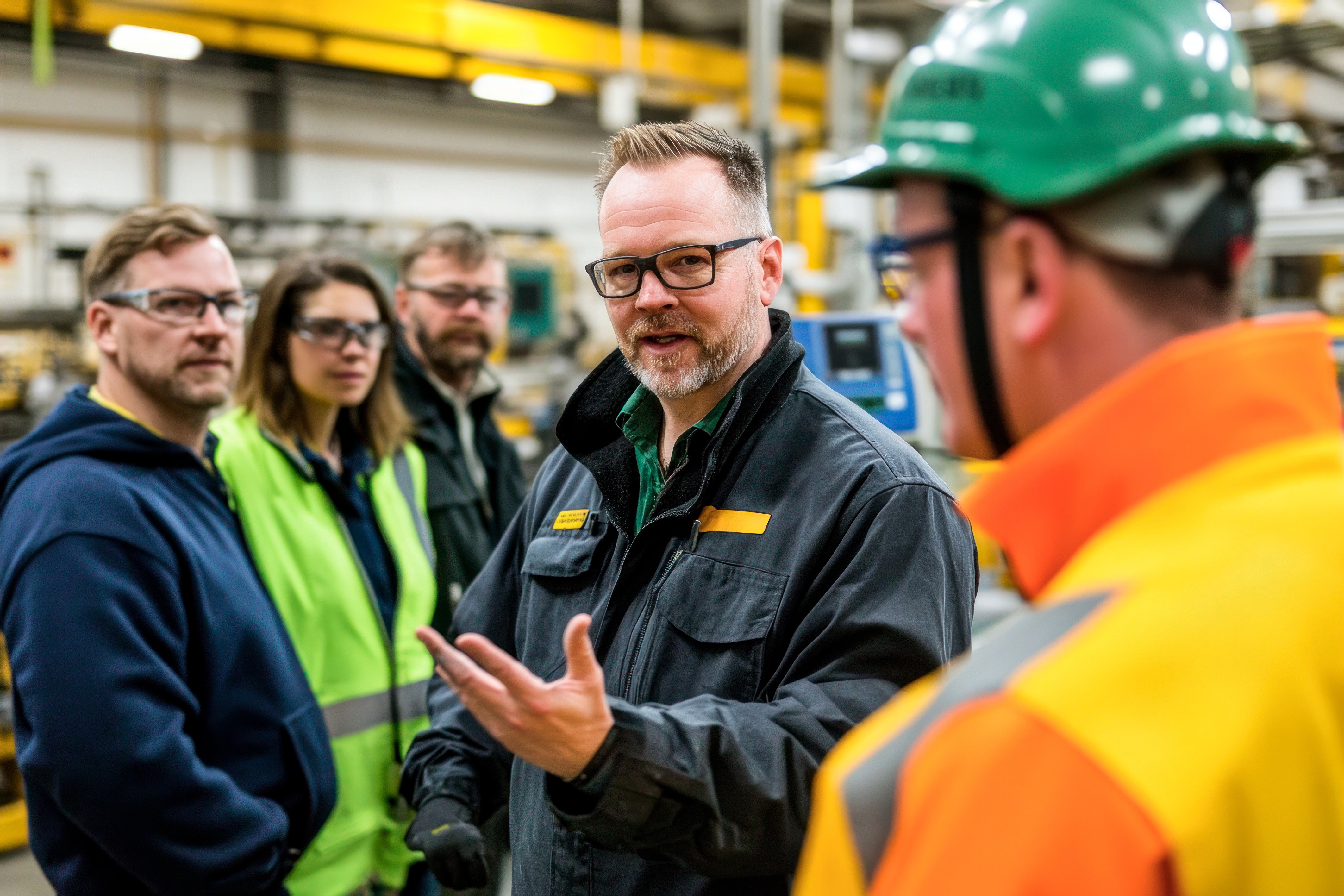

Safety Culture Cannot Be Trained Into Existence It Has to Be Coached Into Behaviour
Posted on
The Manager Who Did Everything Right — And Changed Nothing
A petrochemical facility. A safety manager who had done his homework. He had implemented a behavior-based safety program that included proper design, proper training, observation checklists, and monthly feedback sessions. On paper, everything was in place.
Six months in, the at-risk behavior rate had not moved.
When I asked him what consequence he was using to reinforce the safe behaviors he had identified, he looked at me for a moment. Then he said, "We give out a safety voucher at the canteen."
I asked him how many of the workers on that line used the canteen.
He didn't know.
This is not a story about a failing program. It is a story about a competent safety professional who had mastered the antecedent side of the ABC model — observation, measurement, procedures, and checklists — and had never been taught that consequences actually drive behavior. The voucher was not a reinforcer for most of his team. It was an irrelevance dressed up as a reward. And because it did nothing, the behavior did nothing either.
In 20 years across 47 facilities in the GCC and Western Europe, I have seen variations of this story more times than I can count. Despite correctly building the system and thoroughly training the team, the HSEQ professional remains unable to influence what occurs on the floor. Not because he is incompetent. Because no one taught him what organizational behavior management actually is — or how it applies to safety.
This article corrects that.
The Misconception: Training Creates Culture
Many in safety believe that if you put the right knowledge into people, the right behavior will follow. Run the induction. Brief the toolbox talk. Deliver the training module. Sign the form. Move on.
In fact, training is an antecedent. It tells people what to do. It does not determine whether they will do it. And the gap between knowing the safe procedure and consistently executing it, without supervision, under time pressure, at the end of a shift — that's where incidents live.
The gap between knowing the safe procedure and executing it consistently — without supervision, under time pressure, at the end of a shift — that gap is where incidents live. |
The research behind behavior-based safety—rooted in applied behavior analysis and developed into the discipline of organizational behavior management—has been consistent on this point for decades. Antecedents are weak motivators. They get a behavior started. Consequences (effects) are what determine whether it continues.
Most safety programs spend 90% of their energy on antecedents, such as training, procedures, signage, briefings, toolbox talks, and permit-to-work systems. All of them are necessary. None of them is sufficient. Because when the safety manager leaves the room, the only thing that drives behavior is what happens to the person after the behavior occurs.
OBM is the framework that directly addresses this. It is not a replacement for the systems and procedures already in place. It is the layer that makes them work.
What OBM Is — and Why HSEQ Is Its Natural Domain
Organizational Behavior Management is the application of Applied Behavior Analysis within organisations. It translates the science of behavior — how consequences shape what people do — into a practical protocol for improving performance.
It does not work with attitudes. It does not measure culture as an abstraction. It works with observable, measurable behavior — the things people do or do not do, that can be seen and counted.
In an HSEQ context, this means three things:
1. Specifying exactly which behaviors prevent harm — not "be careful" or "think safety", but observable actions: verifying lockout-tagout isolation before breaking containment and completing a pre-task risk assessment before starting hot work. 2. Measuring the actual frequency of those behaviors—not incident rates after the fact, but the rate of the critical safe behaviors themselves, before anything goes wrong. 3. Designing consequences that make the safe behavior more likely to occur — and removing the conditions that make the unsafe behavior more rewarding than the safe one. |
Most safety programs fail to reach that last point. And it is the reason why HSEQ is, in many ways, the perfect domain for OBM.
Consider what the natural consequence (effect) of unsafe behavior usually is: nothing happens. The person takes the shortcut, skips the PPE, bypasses the check — and finishes the job two minutes faster. No incident. No feedback. The behavior is quietly reinforced by the absence of a negative consequence.
Now consider the natural consequence of safe behavior: it takes longer, it is more uncomfortable, and no one acknowledges it. Over time, without deliberate consequence design, the safe behavior competes against the shortcut and loses.
This is not a morale problem. It is not a training problem. It is a consequence problem. And OBM is the only framework in HSEQ that treats it as such.
The ABC Model Applied to Safety — With Emphasis on the C
The ABC model — Antecedent, Behavior, Consequence — is well known in safety circles. What is less well understood is the relative power of each element.

ANTECEDENT | CONSEQUENCE |
|---|---|
Sets the occasion for behavior | Determines whether behavior continues |
Training, procedures, signage, briefings | Feedback, recognition, correction, and natural outcomes |
Tells people what to do | Decides what people actually do again |
Effect: gets the behavior triggered | Effect: shapes the frequency of the behavior over time |
Power: weak without consequences behind it | Power: primary driver of behavior—always |
In safety, most antecedents are genuinely necessary. A permit-to-work system is an antecedent. A safety briefing is an antecedent. A procedure is an antecedent. Remove them, and the system breaks down. But add only antecedents, and nothing reliably changes on the floor.
The consequence side of the ABC model is where HSEQ professionals consistently underinvest. And when they do invest, they often misapply it — defaulting to generic rewards (vouchers, prizes, bonuses) that are often applied non-contingently.
While both material and non-material consequences are valid, the most powerful reinforcers are frequently immediate, specific, and social—a direct acknowledgement from a manager whose opinion matters:
· A specific, immediate word of acknowledgement from a direct supervisor. · A manager who walks the floor and notices what was done correctly, not what was done wrong. · A near-miss reported and responded to visibly: investigated, acted on, fed back to the team · A recognition in front of peers — calibrated to the person (not everyone wants public acknowledgement). · The simple experience of being seen doing the right thing by someone whose opinion matters. |
The critical principle: not every reinforcer works for every person.
What motivates one operator disengages another. A 25-euro canteen voucher means something different to a shift worker in Amsterdam than it does to a contractor in a labor camp in Jubail. Consequence design requires knowing the person, which is why OBM in safety is fundamentally a coaching discipline rather than a system design exercise.
The Coach vs. The Policeman: Two Postures, One Outcome
There are two ways to stand on a production floor as an HSEQ professional. Both involve observing behavior. One changes it. One doesn't.
THE POLICEMAN | THE COACH |
|---|---|
Looks for what is wrong | Looks for what is right — first |
Arrives when something needs correcting | Arrives before something needs correcting |
Compliance holds while he is in the room | Behavior holds when he has left the room |
Authority and fear as primary tools | Timing and relationship as primary tools |
The seatbelt comes off when he's gone | The person who understood why — keeps it on |
Creates an adversarial dynamic with operations | Builds a partnership with operations |
Uses HSEQ as a control function | HSEQ as an embedded operational discipline |
This is not a question of personality. It is a question of method. The policeman's posture is reinforced by organizational systems that reward compliance counts, audit scores, and incident-free months. Those are legitimate measurements. But they measure the absence of bad things — they do not measure the presence of safe behavior.
The coach's posture is only possible when the HSEQ professional has three things the policeman does not:
1. A clear picture of the specific behaviors that matter most — not vague safety attitudes, but pinpointed observable actions linked to the highest-risk tasks. 2. A consequence toolkit that goes beyond materialistic reward — the ability to calibrate feedback to the individual, delivered immediately, genuinely, and specifically. 3. Relationships with the operation that were built before an incident — not borrowed in the aftermath of one. |
OBM provides the framework. The coaching posture is how it is practiced on the floor.
OBM Coaching in Practice: The 7-Step Protocol Applied to HSEQ
The OBM protocol — as developed by OBM Dynamics and grounded in the Applied Behavior Analysis research of Aubrey Daniels, B.F. Skinner, and decades of industrial application provide a step-by-step framework that translates directly into HSEQ coaching.
Here is what it looks like when applied to a real HSEQ context:
1 | Specify the Performance Identify the 3–7 critical observable behaviors that, if performed consistently, would prevent the highest-consequence incidents in your operation. Not attitudes. Not values. Specific actions: what does safe behavior look like in this task, on this piece of equipment, for this team? The MACRO test applies—behaviors must be Measurable, Active, Controllable, Reliable, and Observable. |
2 | Measure the Baseline Observe and record how frequently those critical safe behaviors are actually performed — before any intervention. Conduct one to two weeks of honest, non-interventionist observation. This baseline is your ground truth. It will almost certainly be lower than anyone expected, which is the point. You can only improve what you have measured. |
3 | Perform ABC Analysis For each critical behavior, map the antecedents that should be prompting it — and the consequences that are actually following it. Ask: What is the consequence for doing it the safe way? What is the consequence for not doing it? In most operations, the unsafe shortcut has a better immediate consequence profile than the safe procedure. Until you change that, the behavior will not change. |
4 | Organise Performance Feedback Design a structured feedback process: when will observations occur, who delivers the feedback, and how will it be framed? Feedback must be specific ("I saw you verify the isolation before opening the flange — that is exactly right"), immediate, and genuine. Data on behavior frequency should be visible to the team — simple charts, on the floor, updated regularly. What gets measured and shown gets done. |
5 | Set Sub-Goals Use the baseline data to set realistic, incremental improvement targets with the team—not for management. Goals that people have agreed are achievable drive effort. Goals imposed from outside drive resentment and, eventually, watermelon reporting: green on the surface, red underneath. |
6 | Reinforce (R+) Deploy positive reinforcement systematically and individually. This is where the coaching posture becomes critical. Walk the floor. Catch people doing the right thing. Acknowledge it specifically, immediately, and sincerely. Calibrate the reinforcer to the person — not every team member responds to the same recognition. The HSEQ coach who builds the relationship before the incident is the one whose reinforcement holds the most power when it counts. |
7 | Evaluate, Adjust, and Conclude Review the data. Did behavior frequencies move in the right direction? Which behaviors are now at habit strength—embedded in the operation, reliably enough to be maintained without intensive reinforcement? Move them into standard practice, and redirect the OBM cycle to the next priority. A safety culture is not a destination but a continuous journey. It is a series of cycles, each one building on the last. |
What Changes in the Operation
When OBM coaching is implemented with fidelity — not as a program dropped into an organization for six months and then abandoned, but as an ongoing discipline embedded in the HSEQ (and most importantly, operational leadership) function — the outcomes are observable at both the leading and lagging indicator level.
LEADING INDICATORS (behaviour-level changes) | → Near-miss reporting increases — workers report because they trust the consequences of reporting → Pre-task risk assessment completion rates rise and the quality of those assessments improves → Observation participation increases: front-line workers begin observing each other → Feedback conversations shift from corrective to recognitional — the ratio changes → HSEQ becomes a conversation on the floor, not an audit event |
LAGGING INDICATORS (outcome-level changes) | → Recordable incident rates decline — as documented in every credible longitudinal BBS/OBM study → Workers' compensation costs reduce: in one manufacturing case cited in ASSE research, from $3.50 to under $0.50 per $100 of payroll over four years → Operational continuity improves: fewer stoppages, fewer production interruptions caused by safety events → Tender performance improves: documented safety culture becomes a competitive differentiator |
None of these outcomes require a new system. They require applying the one science that deals directly with human behavior to the one domain where human behavior determines whether people go home unharmed.
One Warning: OBM Without Data Integrity Is Theatre
The Watermelon Principle: Green on the outside. Red on the inside. When leaders use zero-incident targets as a reward mechanism — and tie bonuses, recognition, or performance reviews to achieving zero — they activate a predictable consequence chain: incidents get hidden, near misses go unreported, and the data that OBM depends on to function becomes fiction. OBM coaching cannot operate on corrupted data. If the consequence structure around incident reporting punishes honesty, the measurement system produces a performance that looks good on paper and delivers nothing on the floor. Zero should be the direction. Not the incentive. The HSEQ coach's first task is often to correct the consequence design at the top of the organisation — before deploying OBM anywhere else. |
The Bottom Line
Safety culture is not a mindset you install with a training program. It is not a value you declare in a policy document. It is the cumulative result of thousands of individual behavioral decisions made by real people under real conditions, when no one is watching.
What determines those decisions is not the last toolbox talk. It is the consequence pattern that those people have experienced — what happened the last time they did the safe thing, and what happened the last time they didn't.
OBM gives HSEQ professionals the framework to deliberately design that consequence pattern, measure whether it is working, and adjust it when it isn't. It is the difference between a safety function that generates documents and one that generates behavior change.
The coach does not wait for the incident to make his case. He builds the relationship, maps the behavior, designs the consequence, and is present on the floor the moment the right thing happens.
That is what changes what people do.
If this article raised questions about what is actually happening on your floor — I am available for a conversation. No pitch. No proposal. A direct discussion about what OBM coaching looks like in your specific operation — and whether it makes sense. Amador Brinkman · amador@techniqueworks.com · Technique Works linkedin.com/in/amadorbrinkman |
© 2026 Technique Works · All rights reserved · techniqueworks.com
#Netherlands
Safety culture
Human factors in safety
Employee engagement in safety
Safety communication
Quality improvement methods
Mental health at work
Safety coaching